 EN
EN

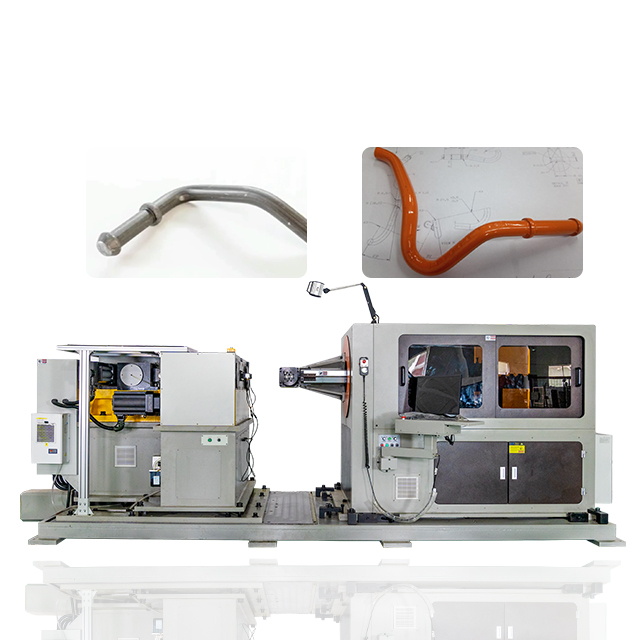
Internal wrinkling can be a real nuisance when tube bending. They don't look nice in the finished part, and they thin the tube wall while also providing constrictions to fluid lines. To get round this, there are two commonly applied techniques for solving inner wrinkling in tubes: mandrel bending and non-mandrel bending. While both have their uses, their effectiveness in preventing inner radius wrinkles could not be more different. In this article we consider each method, in an attempt to establish once and for all what truly solves inner wrinkling.
Understanding Why Inner Wrinkles Form
In effect, when a tube bends, the outer wall has to stretch while the inner wall has to compress. The thin walls of many tubes, or tubes bent to too tight a radius cannot provide enough strength to resist the compressive forces so the inner wall folds over and buckles. This buckling is what causes a wrinkle. Thinner walls, tight bends and materials such as stainless steel (which is naturally quite hard) exacerbate this problem. Any solution to the problem must either support the inner wall of the tube, or find a way to alter the compressive force. Below are two techniques that tackle this issue from two different directions.
Non-Mandrel Bending: Simplicity with Limitations
There are various techniques for bending without the use of internal support, the simplest of which is empty or non-mandrel bending. In this type of bending, the tube is bent using just the bending die, clamp die and pressure die (or sometimes wiper die). No object enters the tube. The method works very well for tubes with a thick wall, bent to a reasonable radius. A tube of 2.5 mm wall thickness bent to a radius of 3D bends nicely without a mandrel. The pressure die pushing the tube forwards, together with the rotating bend die, creates tension on the outer surface, which forces the material to collapse inwards to resist the forces. However, any inner wall thickness less than 1.5mm and inner bend radius greater than 2D will be impossible to avoid inner wrinkling to some extent, as there will be nothing inside the tube to keep it round. The main advantage of non-mandrel bending is that it is faster and has far less tooling than mandrel bending; the trade-off is that it is not really a solution to inner wrinkling.
Mandrel Bending: Internal Support for Wrinkle-Free Results
Mandrel bending is used in this process and incorporates an insert into the tube. Usually a solid rod containing one or more articulated balls, the mandrel supports the inner wall at precisely the point where compression is taking place. As the tube bends, the inner wall is simply prevented from collapsing inwards by the mandrel. The balls themselves are articulated so that as they are pulled through the tube while the latter bends, they can all adapt to the curves made by the tube wall. This is by far the most successful method for dealing with such problems as thin-walled tubes, tight radius bends and hard materials such as stainless steel. For the same scenario outlined in the previous section (25mm diameter stainless steel, 1.2 mm wall thickness, 1.8D bend), an articulated two ball mandrel will produce absolutely no wrinkling on thousands of pipes. As you can see in the accompanying diagrams, the improvement over non-mandrel bending is extremely marked. The main drawbacks of mandrel bending are: tooling cost is significantly higher and it can be very time-consuming on smaller batches, and all parts require lubricant to stop the stainless steel tube from 'galling' against the mandrel surface.
Comparing Performance on Real Applications
Consider a typical car part, a 25 mm tube with a wall thickness of 1.2 mm and a centerline radius of 1.8D. When you are not bending over a mandrell, a degree of wrinkling of the inside will almost invariably be present; some 30% of the part, will be wrinkled. Depending on the part it might be just visible and not critically important for the function of the part, but definitely not aesthetically pleasing and may restrict fluid flow. If that same pipe is bent using a well-designed two ball mandrel, the problem is solved completely, and tens of thousands of pipes are passed without a wrinkle. Medical components are often only available with a wall thickness around 1 mm, and are bent using the mandrel process because it is simply the only feasible method for obtaining an acceptable result.
When Non-Mandrel Bending Is the Right Choice
That said all of that, the use of non-mandrel bending is definitely justified when one is dealing with very thick-walled tube (2 mm or more) and a generous bend radius (3D+), or when time and cost on prototyping are more important than the finish. It is often seen that smaller manufacturers can get away without mandrel tooling by carefully calculating the bend radius based on wall thickness for very thick pipes, and simply not attempt to produce tubes which would require the use of a mandrel for the inner radius. However, if your parts are already wrinkling, and you're using non-mandrel tube bending, adding a mandrel to the setup is really the only obvious answer.
Practical Considerations for Mandrel Bending
It's important to remember that with mandrel bending, one needs the correct die set to achieve optimal results. It is generally accepted that there is a gap of no more than 0.1 mm to 0.2 mm between the wall of the pipe and the internal surface of the outer die for optimal results. Furthermore, the position of the balls relative to the point where the pipe is tangent to the bend die is crucial: Set too far ahead and the mandrel becomes wedged into the tube, set too far back causes the pipe to collapse again. Modern CNC hydraulic tube benders have programmed mandrel withdrawal for an easier setting.
Conclusion
If you wish to eliminate inner wrinkling — whether you are bending a thin-walled pipe with a tight radius, or the part’s appearance is critical — then mandrel bending is definitely the right choice. Non-mandrel is useful in certain circumstances, but cannot solve the core problem itself. All our pipe bending machines here at Baorui are built to facilitate both methods of bending. The selection between one or the other is always application dependent, but if it's wrinkle free tubing you're after, then you can't beat the mandrel.