 EN
EN

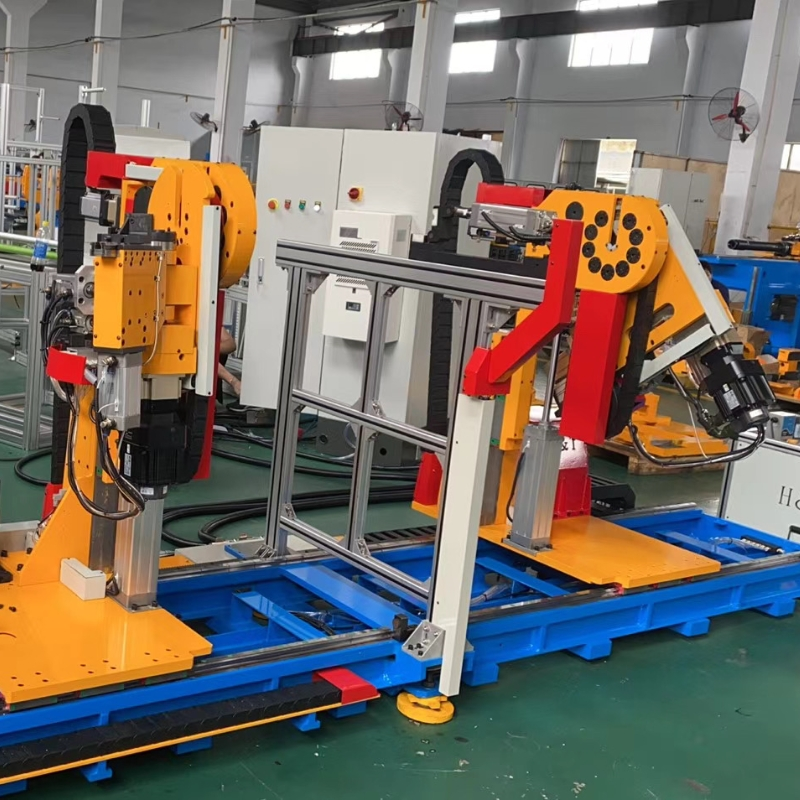
From producing car components and medical equipment to manufacturing furniture, production runs around the clock. Heavy pipe bending equipment is expected to run continuously for weeks at a time with no breaks, during weekends and all night. During a twenty-four hour manufacturing process a break in production, error in the equipment or lack of precision could mean thousands of dollars’ worth of scrapped material and late deliveries. Having spent the last 20 years manufacturing CNC hydraulic pipe benders, pipe cutters and chamfering machines, at Baorui, we know what a heavy-duty bender requires to achieve the reliability necessary for around-the-clock operations. This article explains the essential principles manufacturers rely on to keep these machines running 24/7 without disruption.
Oversized Hydraulic Systems for Thermal Stability
As a hydraulic system is run continuously, more heat is generated, thus increasing its temperature. If the temperature gets too high, hot hydraulic fluid will thin, causing a decrease in system pressure, yielding inconsistent bending forces and increasing part inconsistency and wear on the pumps and valves. Heavy-duty benders use oversized hydraulic reservoirs with the addition of industrial-grade, thermostatically-controlled oil coolers. Larger fluid reservoirs will heat up less slowly, and an oil cooler will keep the temperature within the desired range, irrespective of how long the machine runs. Additionally, some systems will use a variable-displacement pump in place of a fixed-displacement one to generate less heat overall. Be certain to examine the rated capacity of a hydraulic system when comparing benders for round-the-clock use, focusing on the continuous-duty rating rather than simply the peak pressure.
Reinforced Machine Frames and Tooling Mounts
Over time, as a machine repeatedly operates under load, its components can become flexible, alignments can slip and pivot points wear prematurely. Heavy-duty benders have thick steel plates and a greater number of reinforcing ribs throughout. Many machines will undergo finite element analysis (FEA) to identify potential problem areas that will be stressed during the operation before the frame is even designed. Much greater attention is given to the critical tooling mounting surfaces, because any slippage of the dies, clamps or wiper dies will immediately render part tolerances worthless. Reputable manufacturers use precision-ground machine tool mounting surfaces and robust clamping bolts capable of resisting vibration to prevent slipping and keep tooling consistent through thousands of operations. Frames at Baorui are designed with stress tolerances far beyond industrial requirements as we know a frame that flexes today is one that will break tomorrow.
Closed-Loop Feedback Controls That Self-Correct
Because variations in the raw materials being processed, the inevitable wear that will eventually occur in a bender's tooling, and even ambient temperature changes can all affect bend accuracy, closed-loop feedback is a key distinguisher between a light-duty and a true heavy-duty pipe bender. Linear encoders, pressure transducers, and angle sensors on the machine will constantly feedback on the precise operation of each bend to the machine's controller. If any variation from programmed bend parameters occurs during operation, the controller will automatically adjust for that deviation on the next cycle. For instance, should springback increase during a batch of parts due to variations in material hardness, the controller will add overbend to compensate and keep parts within tolerance. Without closed-loop control, cumulative errors would occur through the process, leaving out-of-tolerance parts among thousands produced.
Predictive Maintenance Through Cycle Counting
The traditional reactive maintenance that many facilities employ, i.e., waiting until a machine actually fails, will not suffice for continuous manufacturing operations. Heavy-duty pipe benders and other industrial machinery are instead built with a "predictive maintenance" regimen in mind. The controller on the machine tracks actual cycles performed, as well as factors like total bend force applied, total operating hours, etc. As a wear component approaches the end of its service life (for example, 500,000 bend cycles for a wear plate), a notification will be displayed on the machine that replacement is anticipated and can be scheduled during a non-critical operating period. Many advanced CNC pipe benders will also incorporate sensors to detect changes in hydraulic fluid condition and vibration that may indicate the necessity for such replacements before they become an emergency. The key concept here is: if it is going to fail, do it on the planned schedule.
Tooling Design for Long-Term Consistency
Tooling used with a heavy-duty pipe bender must be as robust and durable as the machine itself in order to achieve sustained consistency in bending. The dies and wiper dies commonly used in pipe bending operations are generally manufactured from wear-resistant tool steels, such as D2 or M2, often hardened further and/or plated with chrome or nitriding for increased lifespan. Even the precise grinding of critical tool surfaces can make a huge difference in bend accuracy, particularly when utilizing quick-change systems so that each set of tooling mounts with the exact same repeatability each time it is changed. For thin wall stainless pipe or more high strength alloys, mandrels with precision ground balls that ride in lubricated stems have been demonstrated to be absolutely critical for wrinkle-free bends for millions of operations.
Conclusion
Ensuring stable, 24/7 operation for heavy-duty pipe benders involves a coordinated effort of multiple factors, from the frame construction to the tooling utilized. A robust hydraulic system with temperature regulation, a closed-loop feedback system and sensors that continuously monitor the process, durable tooling that will maintain precise geometry throughout the bending process, and properly trained operators who know to utilize these features effectively are all integral components to success. At Baorui, these principles are embedded in every CNC hydraulic pipe bender we build and pipe cutting machine. For those facilities fabricating automotive parts, medical instruments or furniture components around the clock, stability isn't just another feature – it is the key to a productive manufacturing process.